
Introduction: The Allure of Dream-State Vertigo
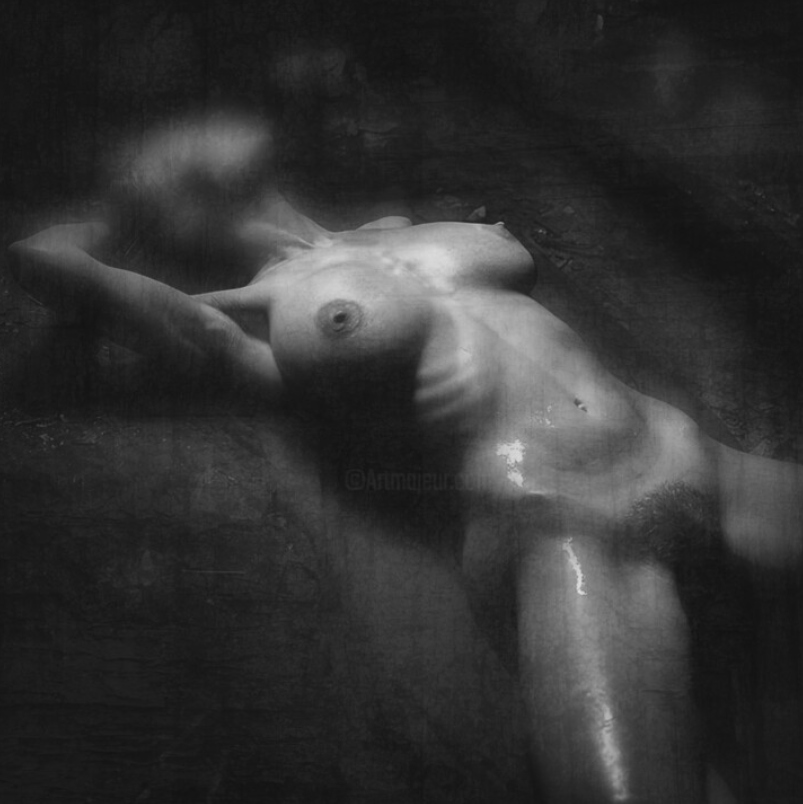
Since the dawn of psychoanalytic inquiry into dreams and the Surrealists’ bold visual experiments, the dream realm has exerted a profound fascination on artists and viewers alike. Oneiric Vertigo—or “Dream-State Vertigo”—embodies this enthrallment with the unknown, the blurry boundary between reality and imagination, and the seductive fear of losing one’s bearings. In this extensive exploration, we will dissect every facet of this enigmatic photograph: its symbols, stylistic influences, technical craft, tonal palette, compositional strategy, and psychological impact. Anchored by both classical and contemporary photographic references, our journey will illuminate how Oneiric Vertigo captures the sublime disorientation of the unconscious.
1. Symbols & Iconography: Fluidity, Ambiguity, Vertigo
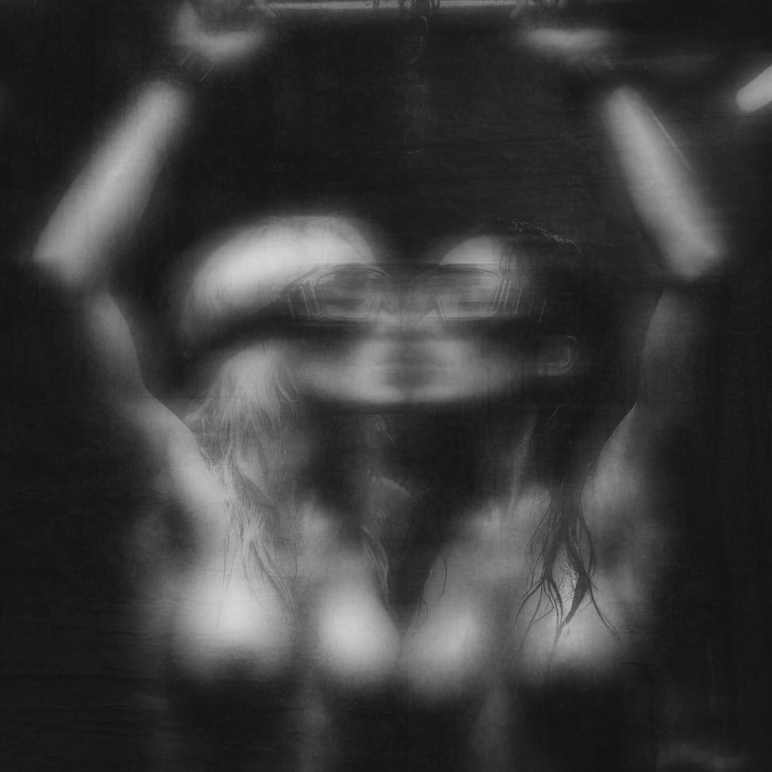
Blurred Identity: The indistinct face and body recall the mutable nature of dreams. Viewers project their own narratives into the void. (See Dorothea Tanning’s dreamscapes.)
Title as Trigger: Oneiric Vertigo signals cognitive disorientation. The photograph’s lack of sharp detail simulates the physical sensation of vertigo.
Subconscious Portal: By obscuring facial features, the image universalizes its subject—an archetype rather than an individual. (Compare Leonor Fini’s explorations of the unconscious.)
Surreal Lineage: Echoes of Man Ray’s rayographs and Hans Bellmer’s doll-bodies underscore the erotic-existential tension in the human form.
2. Style & Artistic Influences: From Classic Surrealism to Contemporary Etéreo
Surreal Foundations: Like Grete Stern’s photomontages, this piece juxtaposes familiar forms into uncanny arrangements.
Ethereal Blur: The soft-focus aesthetic channels Susan Derges, whose aqueous long-exposures dissolve boundaries.
Self-Portrait Ephemera: Francesca Woodman rendered bodies as fleeting phantoms—an influence felt in the image’s vanishing contours.
Darkroom Dreamscapes: Jerry Uelsmann’s analog composites presaged today’s layered, dreamlike photography.
3. Medium & Techniques: Crafting the Blur
Photographic Print: Printed on archival cold-fiber paper for rich tonal depth.
Optical Desfoque: A prime lens at f/1.2 yields razor-thin depth of field—an homage to Félix Vallotton’s soft-focus portraits.
Intentional Motion: A shutter speed around 1/4 second captures subtle motion blur, reminiscent of Josef Sudek’s ghostly interiors.
Minimal Post-Processing: Contrast and exposure tweaks in the darkroom preserve the tactile quality of the original negative.
4. Tonal Palette: Monochrome Mystery
Grayscale Range: From deep charcoals to silvery highlights, the monochrome palette cites Bill Brandt’s dramatic noir style.
Texture Emphasis: In absence of color, skin, hair, and background textures gain prominence—an approach championed by Ralph Gibson.
Emotional Neutrality: Stripping color away focuses the viewer on form, shadow, and gesture.
5. Composition: Central Focus & Layered Depth
Focal Core: The blurred face anchors the center, demanding the viewer’s attention—a tactic similar to Grete Stern’s dream-portrait arrangements.
Background Silhouette: A softly defined body behind the face creates a portal-like framing device.
Unstable Equilibrium: Slight asymmetries in shoulder alignment inject a subtle tension, mirroring the vertiginous theme.
6. Line & Form: Dissolving Boundaries
Dynamic Softness: Fading edges convey transition—solid body to ephemeral apparition—much like Francesca Woodman’s dissolving self-portraits.
Organic Geometry: Vertical hairlines contrast with gentle curves of the body, echoing Hans Bellmer’s twisted forms.
Psychic Disruption: Blurred contours disrupt Cartesian logic, evoking a dream’s non-Euclidean topology.
7. Texture & Detail: The Allure of Smooth Surfaces
Velvety Finish: The optical blur suggests skin’s soft, tactile quality—an effect explored by Susan Derges.
Absence of Sharpness: De-emphasizing pores and wrinkles invites a meditative gaze, akin to Ralph Gibson’s focus on pure form.
8. Tactile Impression: Imagined Touch
Velvet & Mist: The viewer senses a tactile velvet-mist texture, a barrier preventing direct contact and heightening intrigue.
9. Light & Shadow: Subtle Modeling for Emotional Depth
Moderate Contrast: Gradual tonal shifts mirror Mario Giacomelli’s use of midtone compression to evoke mood.
Sculpting Shadows: Soft shadows around facial contours suggest motion and depth, a technique refined by Sarah Moon.
10. Treatment of Human Form: Enigmatic Presence
Deliberate Depersonalization: Blurring the face taps into the Jungian notion of the fragmented Self.
Body as Symbol: The figure becomes an emblem of dream-logic, much like Man Ray and Hans Bellmer did in their quest to deconstruct identity.
11. Perspective & Spatial Ambiguity: Reality vs. Hypnagogia
Shallow Spatial Cue: A faint depth of field suggests receding space, simulating the shiftiness of dream locales.
Layered Blurs: Overlapping planes of blur create the sensation of drifting in and out of focus—mimicking rapid eye movement during sleep.
12. Creative Research & Experiments: Journey to the Dream Realm
Dream Journals & Analysis: Document nightly dreams, identify recurring symbols.
Surrealist Exhibitions: Study works by Salvador Dalí, René Magritte, and Leonor Fini.
Experimental Workshops: Practice soft-focus and long-exposure techniques in controlled studio settings.
Location Scouting: Follow Georgie O’Keeffe’s model—seek stark, otherworldly landscapes as backdrops.
Analog Processes: Emulate Jerry Uelsmann’s darkroom collage methods to layer dream fragments.
13. Viewer Experience: Intrigue, Unease, Reflection
Intrigue & Projection: The viewer’s psyche fills the void left by the blurred visage, crafting personal narratives.
Cerebral Vertigo: Attempting to anchor one’s gaze in a featureless point triggers a mild cognitive dissonance—a gateway to introspection.
Emotional Distance: The absence of recognizable expression creates a tension between empathy and estrangement.
14. Essential Reading & Technical Resources
John Szarkowski, The Photographer’s Eye (1966) – Foundations of photographic form.
John Berger, Ways of Seeing (1972) – Visual perception and semiotics.
Roland Barthes, Camera Lucida (1980) – Emotional resonance of photography.
Susan Sontag, On Photography (1977) – Cultural role of the photograph.
Bruce Barnbaum, The Art of Photography (1994) – Personal expression techniques.
Henri Cartier-Bresson, The Mind’s Eye (1999) – Capturing ephemeral moments.
Bryan Peterson, Understanding Exposure (1990) – Mastering aperture and shutter speed.
Freeman Patterson, Photography and the Art of Seeing (1985) – Developing a creative vision.
Stephen Shore, The Nature of Photographs (2007) – Structural analysis of images.
Jay Maisel, Light, Gesture, and Color (2014) – Using light and movement for narrative.
15. Suggested Books & Films for Further Exploration
Books
Invisible Man by Ralph Ellison (1952)
The Unbearable Lightness of Being by Milan Kundera (1984)
The Bell Jar by Sylvia Plath (1963)
Blindness by José Saramago (1995)
Slaughterhouse-Five by Kurt Vonnegut (1969)
Kafka on the Shore by Haruki Murakami (2002)
Films
Lost in Translation (dir. Sofia Coppola, 2003)
Eternal Sunshine of the Spotless Mind (dir. Michel Gondry, 2004)
Inception (dir. Christopher Nolan, 2010)
Donnie Darko (dir. Richard Kelly, 2001)
Mulholland Drive (dir. David Lynch, 2001)
Embracing the Vertigo of Interpretation
Oneiric Vertigo does not hand us clear answers; it offers an experience—a plunge into aesthetic vertigo where dream logic reigns. By weaving classic Surrealist motifs, analog techniques, and contemporary sensibilities, this photograph invites us to confront the fluid boundaries of self and reality. Each viewer leaves the encounter with their own personal reverie—a testament to the enduring power of the dreamscape in art.
For inquiries or to commission a unique original collectible print of Oneiric Vertigo, please contact Hueb Arts at info@huebarts.com or visit ArtMajeur Store.